Polar Body Diagnosis (PBD)
Polar bodies are small particles that contain excess genetic material (chromosomes or chromatids) and are expelled from the oocyte during oocyte maturation and fertilisation. Polar bodies are no longer needed for the embryo’s further development; however, they contain genetic information that reflects the status of the oocyte.
What can polar bodies be used for?
Polar bodies and the DNA they contain can be isolated. DNA analysis allows conclusions to be drawn about the genetic information remaining in the oocyte that was passed on from the mother to the oocyte. This makes it possible to detect both mis-segregations of entire chromosomes or chromosome segments during the first and second meiotic divisions, as well as gene mutations that have previously been identified in the mother.
When can polar body analysis be performed?
Polar body analysis is only possible in the context of assisted reproduction (IVF) when IVF is performed using ICSI (Intracytoplasmic Sperm injection). In contrast to preimplantation genetic testing on trophectoderm cells (cells of the embryo), polar body diagnostics are generally permitted by law in Austria and may be performed in any laboratory authorised for this purpose.
Which laboratories in Austria are authorised to perform this can be checked in the Genetic Analysis Register.
Can all genetic changes be detected by polar body diagnostics?
No—polar body diagnostics can generally only detect changes that originate from the mother. For chromosomal mis-segregations such as trisomy 21 (Down syndrome), however, this accounts for the vast majority, and only 2–8% of these deviations originate from the father.
When is polar body diagnostics useful with regard to chromosomal mis-segregations?
Chromosomal mis-segregations can also occur in young women; however, the risk increases significantly with age. The following graphic shows that, as the patient’s age increases, the proportion of euploid oocytes (oocytes with the correct number of chromosomes) decreases. Statistically, in a 39-year-old woman, only one out of three oocytes has a normal chromosome set, while the other two show chromosomal mis-segregations. The aim of polar body diagnostics is to identify the oocytes with a normal chromosome set and therefore the potential to result in a healthy pregnancy.
The following table illustrates the decline in the number of error-free oocytes during maturation and fertilisation:
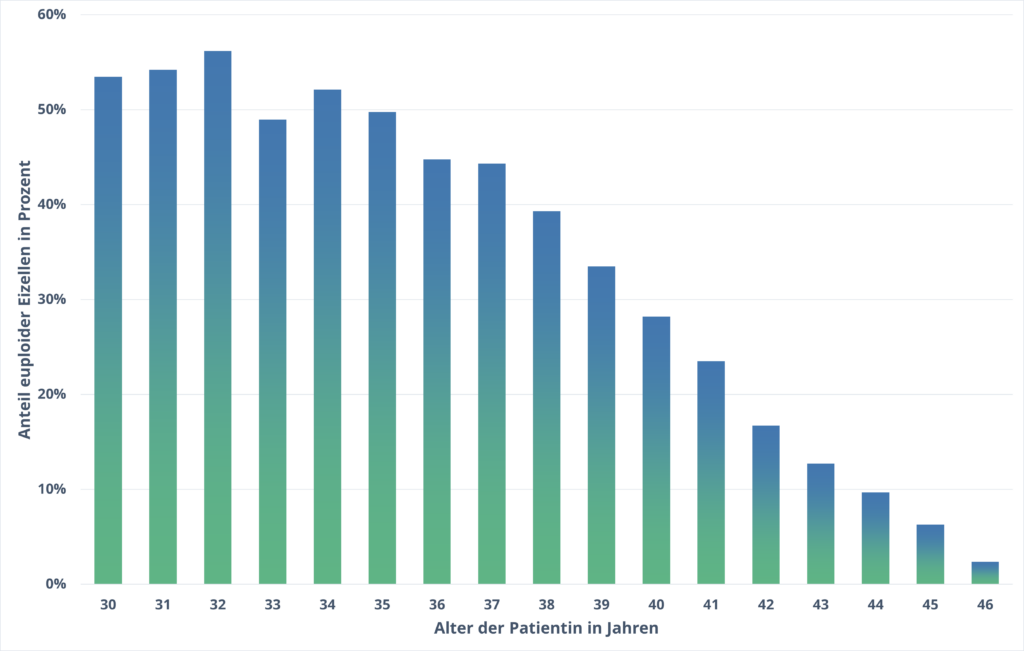
Even in 35-year-old patients, after polar body analysis only half of the oocytes still show a normal chromosome set. The proportion of euploid oocytes decreases continuously with increasing age. A pregnancy resulting from fertilisation of an aneuploid oocyte can lead to miscarriage, implantation failure (failure of the embryo to implant) or, in some cases, the birth of a child with severe health impairments.
How does polar body diagnostics work?
The polar bodies are removed at the reproductive centre as part of IVF treatment and sent to our laboratory under cooled conditions. As polar bodies contain extremely little genetic material (three haploid genomes), the amount of DNA must first be amplified. This is done using so-called whole genome amplification (WGA). After successful WGA, the polar body DNA can be analysed for gains or losses of entire chromosomes or chromosome segments. The reproductive centre is informed of the result once the analysis has been completed.
What are the advantages and disadvantages of PKD?
- Oocytes with the best developmental potential are identified, increasing the likelihood of pregnancy
- Only minimally invasive manipulation of the embryo is required
- Avoidance of transfers of non-viable embryos
- Reduction in spontaneous pregnancy loss
- Pregnancy success after fewer IVF attempts
- Only chromosomal mis-segregations inherited from the mother can be detected (2–8% originate from the father)
- The costs of polar body removal and genetic testing must be paid privately
- The test provides reliable results in only 95% of cases
Where can PKD be performed?

In principle, polar body diagnostics may be performed in any laboratory authorised by the Ministry of Health. In Austria, HLN Genetik GmbH is the only legally authorised private laboratory permitted to perform both polar body diagnostics and preimplantation genetic testing on trophectoderm cells. This means HLN Genetik can draw on many years of experience in this field of human genetics.
If you wish to use polar body diagnostics, please enquire in advance at your fertility centre whether this test can be offered.
The HLN Genetik team will be pleased to assist you in establishing contact.